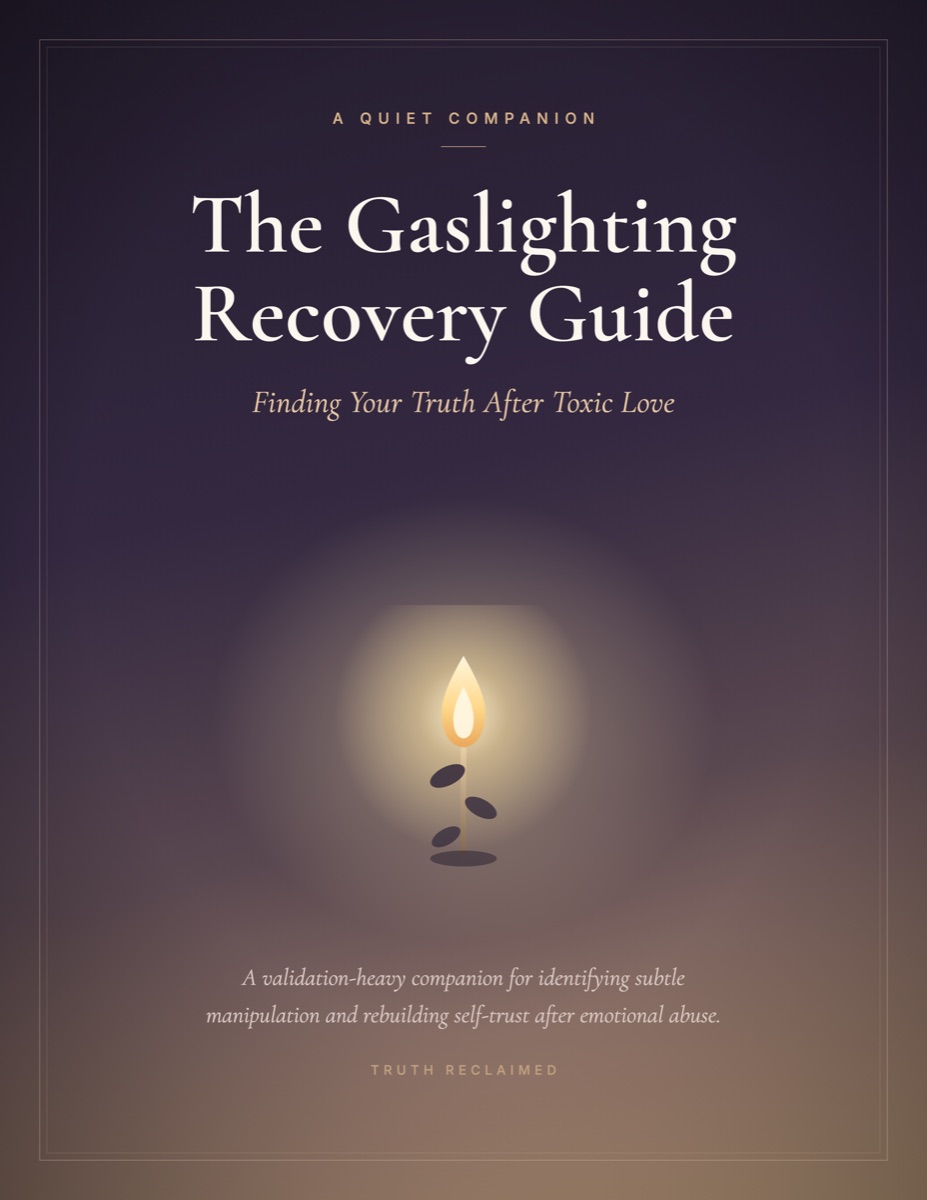
A gentle, trauma informed guide for naming what was done to you, understanding why it still lives in your body, and slowly returning the last word on your own reality back to you.
If your chest tightened even once reading that list, you are exactly who this was written for.
The cruelty was never only the dimming. The cruelty was the insistence that the lights had always been this low.
Being lied to is painful. Being told, patiently and often, that you imagined the lie is a different kind of injury. It teaches you to distrust the one instrument you cannot live without, which is your own perception. This guide is the slow work of calibrating that instrument again, gently, until it reads true.
Forty pages, arranged as four parts and fifteen chapters, with twelve small practices you can do by hand or in your head. You do not read it front to back. You read it the way you can bear to.
For a practical overview before the full guide, read the gaslighting recovery guide.
Language precise enough that the fog turns back into events you can name and hold.
Why you flinch, why you grieve, why none of the lingering is a moral failing.
Small, low stakes practices that hand the authority over your reality back to you.
Boundaries, early signs, and learning to let calm finally feel like home.
The word has been worn thin from overuse. It gets reached for now in every ordinary disagreement, every small revision of a shared story. So let us be precise, because precision is one of the things that was taken from you, and precision is one of the first things we are going to take back.
Gaslighting is not being wrong in an argument. It is a sustained effort to make you doubt your own memory, your own senses, your own grip on what is real, until you hand the keeping of reality over to the very person distorting it.
Not a moment before. The first pages are free so the decision stays yours.
This guide is a companion, not a clinician. It is not a substitute for therapy, crisis support, or medical care. If you are in danger, or if any of this brings up feelings you cannot manage alone, please reach out to a qualified mental health professional or a crisis line in your country. In the US, you can call or text 988 (Suicide & Crisis Lifeline) any time, or contact the National Domestic Violence Hotline at 1-800-799-7233. There is no finish line here. Read at your own pace.
You're not crazy. You never were.